Thursday, January 17, 2013

Tail-Shapes and Color-Variations

Today, let’s take a look at tail-shapes and color patterns of Bettas. Bettas come in a variety of different shapes and vibrant colors; this is due to the process of selective breeding. Selective breeding is the process of choosing a male and female for their specific traits, which would be passed on to the fishes’ spawn (also known as fry). I will be showing photos of only male Bettas so you can properly see the tail-shapes at their full potential.

Tail-Shapes


(My Betta Boy, Ares.)

Veil Tail: The Veil-tail Betta, is possibly one of the most commonly found Bettas in pet stores/aquarium shops. The Betta’s caudal (tail) fin arches and slopes downward creating an appearance much like the shape of a wedding-veil (hence the name).


(This is Poseidon, a Betta I rescued from Meijer; he had internal parasites, which I was able to successfully cure. Sadly, he passed away last September, at the age of 6, due to old age.)

Crown Tail: The crown-tail Betta is also very commonly found in pet stores/aquarium shops. Crown-tail Bettas have particularly delicate fins, which become brittle if water parameters are not cared for correctly.

(Photo provided by: fighterfishlebanon.e-monsite.com)

Half-Moon: The half-moon Betta is, yet again, also a very popular form that you may see in pet stores/aquarium shops. When this Betta flares, their tail appears to be in the shape of half a moon. Betta tail names are sometimes self-explanatory.
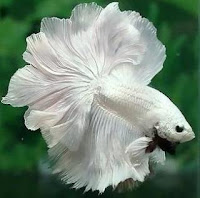

(Photo provided by: betta-forum.net)
Rose-Tail: The Rose-Tail Betta is an accidental discovery, due to the breeding of half-moon Bettas. Over-lapping of the rays in the caudal (tail) fin, cause these Bettas to have a rose-like appearance in their fins. These Bettas are also commonly referred to as Feather-Tailed Bettas.

(Photo provided by: petadvice.com)

            Spade Tail: The spade-tail Betta has a wide caudal (tail) fin base which narrows into a sophisticated point; resembling a spade. These Bettas are not seen very often anymore; however, it is possible to purchase them from an online vender.


(Photo provided by: bettafish.com)

            Double Tail: The double-tailed Betta does not actually have two tails. This is a mutation which causes the Betta’s rays to be doubled in number, and collected into two separate bunches. This is what causes the tail to appear to be split in half. Double-tailed Bettas commonly have swim-bladder issues due to the stunting of the length of their bodies.


(Photo provided by: amberbettas.webs.com)

            Plakat Betta: The Plakat Bettas have short finnage, stronger jaws, sharper teeth, and their scales are also harder which help them fend off disease. Sadly, these Bettas are also a favorite among fighting enthusiasts due to their tough scales and strength (Please note that it is illegal to fight Bettas, as it is considered animal cruelty). These Bettas are allowed to move more quickly due to not being bogged down by the excessive weight of their long-finned relatives. These Bettas may also be referred to as Dragon-Scale Bettas and are commonly found in pet stores such as Petsmart.

            There are many varieties of tail-shapes in Bettas today, and more are constantly being discovered. These (above) are just the ones I have run into through my experience and time with Bettas.


Color-Variations

Now let’s move on to color-variations. Wild bettas do not actually possess the colorful variations you see in domesticated bettas; Wild bettas actually have short fins and very little color (mostly brown). Some wild Bettas, however, are exceptions to this rule.

(Photo provided by:  natureye.com)

This is a Betta Macrostoma, one of many variations of wild Bettas. This Betta is very colorful for being a wild Betta, yet still possesses the short finnage found in wild Bettas.

There are six major color variations found in domesticated Bettas. However, more color variations are being discovered; just like tail-shapes.


            Solid-colored: Solid-colored Bettas have one color which covers the entire body. Sometimes, these Bettas will have imperfections, which breeders are working to eliminate. These could range from small specks of other colors or colored faces. (Tullock) (To me, it really doesn’t matter; I think they are beautiful all the same. Autolycus has a black face, and I think it is adorable!)


(My Betta, Phoebe is a perfect example of a bi-colored Betta. Her fins are dark pink while her body is light pink)

            Bi-colored: Bi-colored Bettas have a body that is one solid color. The fins are a lighter or a darker version of the body color. (Tullock)

(Photo provided by: bettas-jimsonnier.com)

            Cambodian-colored: Cambodian-colored Bettas have a body of one color and fins of another. This can also apply to bettas that have a colored body and transparent fins. (Tullock)


(Photo provided by: animal-world.com)

            Butterfly-colored: Butterfly-colored Bettas have a body of one color, which blends into the fins near the torso area. Then, the outer edges of the fins possess a different color. (Tullock)
(Photo provided by: bettascapes.com)

            Cambodian-butterfly-colored: The Cambodian-butterfly Betta is a cross between Cambodian and butterfly color variations (as the name suggests). The body is one color, while the fins consist of two different colors. (Tullock)

(Photo provided by: flickr.com)

            Marble-colored: The marbled Betta is quite unique. The body and fin tips are the same color; however, the inner portion of the fins is a completely different color. (Tullock) Sometimes, marbled Bettas can have splotches of one color on their bodies and fins and the rest of them are a different color. Marbled bettas also change their appearance with age. You could have a solid blue betta and within a couple months he will be blue and white!


*I hope you all enjoyed today’s post and learned something new and exciting about Bettas!*


Sources which I will be using are from personal experience, and three of my favorite books dedicated to this topic:


Alderton, David. Bettas and Gouramis. Irvine: BowTie Press, 2004.

Robert J. Goldstein, Ph.D. The Betta Handbook. Hauppauge: Barron's, 2004.

Tullock, John H. Your Happy Healthy Pet Betta. Hoboken: Wiley Publishing Inc., 2006.


Thursday, January 10, 2013

Body Functions and Senses


            Today, I’m going to be discussing aspects of the body and how bettas use their senses. This will give you a better understanding of how a betta survives and functions in an environment. Let’s start off with the mouth structure.

The Mouth


(Starting from the left: Leo, Ares, and Autolycus)

           
           The Betta’s mouth is possibly one of its most interesting features. Bettas have rows, upon rows of tiny, sharp teeth. In proportion to body size, a betta’s jaw is larger and stronger than that of the great white shark! Pretty cool, huh? However, don’t let that scare you off; bettas are also gentle parents. They use their mouths to scoop up their young, and deliver them to the nest safe and sound (We’ll talk more about parenting later on). A betta’s mouth is upturned, which is known as the superior mouth position. This allows the Betta to eat from the surface of the water, scoop up their young, and tend to their nests. (Tullock)

The Swim Bladder

            Let’s move on to the swim bladder. Like many other types of fish, the betta has an organ called the swim bladder. The swim bladder is filled with gas that allows the betta to rise and sink in the water, just by making minor adjustments to the gas pressure inside the organ. (Tullock) Over-feeding can cause the betta to lose buoyancy in the water, rendering the swim bladder completely useless until digestion. We’ll talk more about this problem later and how to avoid/treat it.

Senses 

            The senses of the betta are both similar and completely different compared to human’s senses. I will explain how Bettas see, hear, taste, smell, and even detect potential threats.

WARNING: Do not try the example of betta alignment below! This is stressful to the betta and disorienting; not to mention CRUEL!!!

Vision: Betta’s rely on their eye-sight alone to align themselves in the water; they do this by detecting light, which is usually directly above them reflecting off the water surface. According to John Tullock, “If you shine a flashlight into the side of an otherwise darkened tank, the Betta will usually swim sideways, positioning itself appropriately to the false “up” position. Change the direction of the light again and the Betta will orient accordingly.” Bettas cannot adjust to change in brightness as easily as people can. If you turn on an aquarium light in a darkened room, the betta will act startled. Turn on room lights first in order to avoid this problem. Each of the betta’s eyes produces a different image, known as monocular vision. A Betta lacks depth perception and can only focus on objects that are about a foot away. (Tullock)


Hearing: Betta’s ears are a simple inner chamber that detects vibrations passed over sensory components within the chamber to provide sound. It is also believed that the swim bladder assists the inner chamber to amplify and distinguish sound patterns. (Tullock)


Taste and Smell: The way in which bettas taste is quite fascinating. Bettas have taste buds located at the mouth, lips, and even…the fins! Bettas detect smells through the nostrils, just like you and I. These senses allow bettas to respond to chemicals in the water; such as the presence of food, and predators. (Tullock)


Lateral Line: Among the most interesting Betta senses is the lateral line. Bettas rely on the lateral line to locate nearby objects, find food, avoid obstacles, and detect predators. Due to their poor eye-sight, the lateral line is very beneficial to the betta. The lateral line has small holes along it which enable water pressure to affect specific nerve endings. The fish’s brain interprets the nerve signals as an image of the Betta’s surroundings! (Tullock) If the betta were to lose its eye-sight all-together, it would still be able to see its environment through mental imagery. Pretty neat, huh?

            Thanks for reading, I hope you enjoyed today's post! Please feel free to leave some comments or ask questions!


Sources which I will be using are from personal experience, and three of my favorite books dedicated to this topic:


Alderton, David. Bettas and Gouramis. Irvine: BowTie Press, 2004.

Robert J. Goldstein, Ph.D. The Betta Handbook. Hauppauge: Barron's, 2004.

Tullock, John H. Your Happy Healthy Pet Betta. Hoboken: Wiley Publishing Inc., 2006.

Tuesday, January 8, 2013

Brief Introduction to Myself and Bettas


Hello to everyone who’s reading; my name is Hillary and I’ve decided to write a blog about bettas. I’ve kept and bred bettas for 8+ years now; however, I’m taking a much needed break from breeding bettas. I am now just keeping and caring for them as companions. I currently own 6 bettas; three males and three females, which you will see photos of through-out my blog. The large photo on my blog is Leo; he is a half-moon betta and is currently 1 ½ years old. I love bettas and everything about them; to me they are one of the most majestic and interesting fish in existence. Sadly, bettas are also one of the most misunderstood fish in existence (along with goldfish), that is why I’ve decided to write this blog. In this blog, I will be sharing what I’ve learned about bettas through the years. I will be discussing proper care, tank set-ups, treating and recognizing illnesses, suitable tank-mates, breeding, and much more! I hope all of you will learn something new every day and discover how wonderful these fish really are!

Betta Splendens, or more commonly known as the Siamese fighting fish, are members of the Anabantoids (such as the Blue Gourami). The Anabantoids are commonly known as labyrinth fish, due to a special bone above the gill chamber (the labyrinth organ), which allow these fish to breath air from the surface of the water. (Robert J. Goldstein) However, the labyrinth organ is only a second option to get oxygen for survival purposes. It is commonly believed that Bettas originate from "The Ring of Fire," I'm sorry, but they are wrong here...Bettas originate mainly from Thailand, but have been distributed in the wild.


Let's take a look at the parts of a betta:


This is my Betta Boy Ares and he's going to help us out with this one. Let's talk about the lateral line; you probably can't see it on Ares can you? When bettas are stressed they have a dark (sometimes even light) line running horizontally down their sides. This could be due to inaccurate water parameters, illness, even stress from being picked on by tank-mates; we’ll discuss the other functions of the lateral line later on.
The Gill Coverings are used to protect the betta's gills. Yes, bettas have gills in addition to the Labyrinth Organ. When a betta flares, these gill coverings stand out. We'll talk more about flaring later on.
The Gill Slit is cut longer on the betta then on most fish. This is what allows the betta to pull the gill coverings away so far from its body.
The Caudal Peduncle is the narrow part of the betta's body that connects to the caudal (tail) fin. This portion of the betta's body holds just as much (if not more) muscle mass as the betta's jaw.
The Vent is how the betta evacuates his/her waste; I don't think we need another explanation (lol). Now that we have the basic body covered, let's move on to the fins.
The Dorsal Fin is used to keep the betta balanced in the water, without the dorsal fin, the betta would have a difficult time staying upright.
The Caudal (Tail) Fin has many purposes; the betta uses this to propel itself forward through the water (with the help of the caudal peduncle), acting as a rudder. The caudal fin also helps the betta to fan bacteria away from their nests, keeping their babies happy and healthy while they are growing.
The Anal Fin is also a means of balance in the water, much like the dorsal fin.
The Pectoral Fins allow bettas to steer through the water, and may also be used to tend to their nests.
The Pelvic (Ventral) Fins are also used for steering and balance. (Tullock)


Sources which I will be using are from personal experience, and three of my favorite books dedicated to this topic:


Alderton, David. Bettas and Gouramis. Irvine: BowTie Press, 2004.


Robert J. Goldstein, Ph.D. The Betta Handbook. Hauppauge: Barron's, 2004.


Tullock, John H. Your Happy Healthy Pet Betta. Hoboken: Wiley Publishing Inc., 2006.